Glenrich Campus Facilities Guide: A Tour Through the School of Life
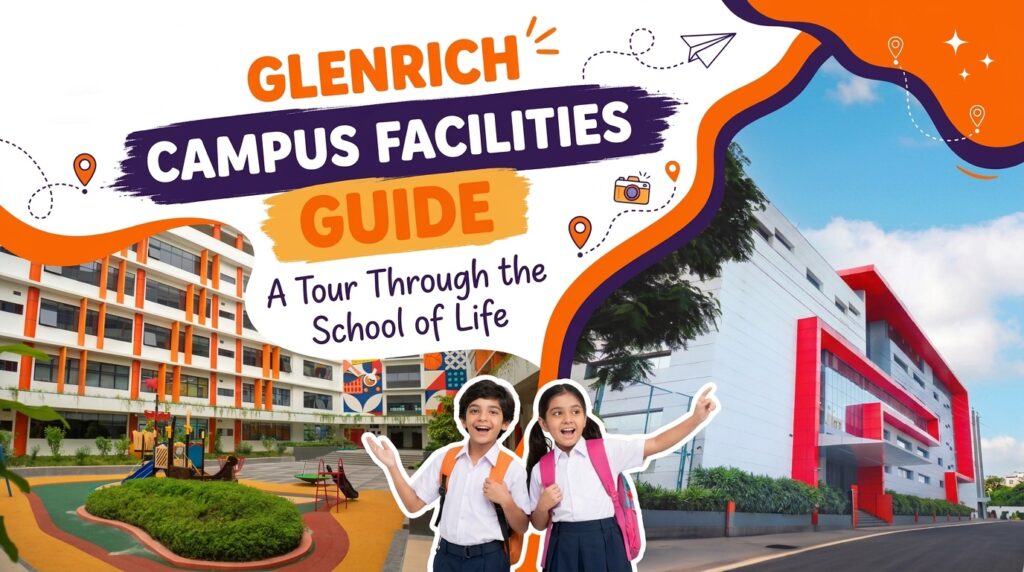
Glenrich International School is a Cambridge curriculum, English-medium school in Dhaka, run by STS Group, with campuses in Satarkul and Uttara, serving Playgroup to Grade 12 (A Level) for children aged two and a half years old to eighteen and a half years old. This guide sets out what each campus offers in the 2026–27 session, what a Glenrich education includes, and what sets its facilities apart among English-medium schools in Dhaka. Parents often say the hardest part of choosing a school is knowing what it offers: which programmes are part of the school day, which services are optional, and what each campus has on site. This guide answers those questions in one place. What is part of a Glenrich education? Every Glenrich student follows the Cambridge curriculum alongside partner-run programmes that many Dhaka schools offer only as optional add-ons. The table below shows which are part of the school programme and which are optional services families can choose. Programmes and services at Glenrich Facility or programme Partner or standard Part of the school programme? Swimming lessons Semi-Olympic standard rooftop pools (Satarkul and Uttara Senior); learner and splash pools for younger swimmers Yes Skating Purpose-built skating rinks Yes Robotics programme STEMROBO Curriculum-embedded sessions; optional after-school activities also available French language programme Alliance Française de Dhaka Yes Music programme ABRSM-accredited Lessons and ensembles; ABRSM exams optional Math Lab Math Buddy Yes Cafeteria meals Weekly rotating menu, staff nutritionist Optional service School transport CCTV-monitored vehicles with on-board supervisors Optional service Cambridge board exam registrations IGCSE, AS and A Level, administered directly in school as a Direct Cambridge School Registered separately per Cambridge exam session The school orders textbooks and uniforms each session through its pre-order process. What facilities does the Glenrich Satarkul campus have? Glenrich Satarkul is the STS Group campus at Plot E-2 and E-3, Sunvalley Sharoni, Block A, Satarkul, Badda, Dhaka. It opened for the 2023–24 academic session and teaches Playgroup to Grade 12 under its current Principal, Mr Manoj Kumar Tiwari. Glenrich Satarkul is a purpose-built campus, with academics and sports at its centre. A rooftop semi-Olympic standard swimming pool is heated for year-round use, with a two-foot-deep learner pool for younger swimmers and certified national-level instructors supervising every session. Alongside it are a purpose-built indoor skating rink, the first of its kind in Bangladesh, regulation-size basketball courts, a secondary court for Physical Education (PE), a green football field and an indoor gym, all described on the Satarkul sports facilities page. Classrooms are smart equipped with interactive flat panels (IFP) and campus Wi-Fi. Early Years and Primary children use a Montessori Lab, a soft play area and the Math Buddy powered Math Lab. The cafeteria is run by a food and beverage team of more than 30 people, including an executive chef and a nutritionist, and parents waiting at pick-up have their own Parents’ Lounge, “a cosy haven for comfort, community & coffee”. The Satarkul campus also has a library of more than 5,000 square feet that seats 90 students, and four computer labs, as listed on the Satarkul campus facilities page. What facilities do the Glenrich Uttara campuses have? Glenrich Uttara operates on the campuses formerly known as DPS STS School Dhaka, so earlier references to DPS STS in Uttara describe the same school under the same STS Group ownership. The Uttara campuses run as two sites under their current Principal, Dr Amlan K. Saha, who brings more than 27 years of school leadership experience, as set out in Glenrich Uttara’s profile of his leadership. The Junior School is at Plot 4, Road 13, Sector 6, Uttara, Dhaka, and teaches Playgroup to Grade 5. The Senior School is at Plot ED-01, Road 1, Sector 15, Uttara, Dhaka, and teaches Grades 6 to 12 (A Level). Splitting the school across two sites keeps the youngest children in a smaller, quieter setting while older students share labs and courts sized for secondary sports. Each Uttara site has its own pool and skating rink. The Senior School has a heated rooftop semi-Olympic standard pool measuring 81 by 43 feet (about 25 by 13 metres), with six lanes and a depth running from 6.5 feet down to 3.25 feet, and an indoor skating rink on the sixth floor. The Junior School has an above-ground splash pool, 24 by 16.5 feet and 3 feet deep, and an outdoor skating rink beside its basketball court. The Uttara campuses offer the same programme set as Satarkul: Robotics Labs with STEMROBO, French with Alliance Française de Dhaka, Math Labs with Math Buddy, the ABRSM-accredited music programmes, a Montessori Lab, smart classrooms, skating rinks, cafeterias and Parents’ Lounges. What makes Glenrich’s facilities stand out in Dhaka? Across its campuses, the school brings together facilities that most Dhaka families would otherwise have to find at several different schools and clubs. For sport, that means a heated rooftop pool with a learner pool, a skating rink, an indoor play area and a regulation-size basketball court. Beyond the core curriculum, it means robotics labs, accredited French and music courses, and Math Labs. For the youngest children, it means a Montessori Lab and a soft play area. The result is a Cambridge education with facilities usually associated with Dhaka’s best-equipped international schools. A heated pool, an indoor play area and skating rinks, alongside partner-run robotics and French and an accredited music programme, make a combination few Dhaka schools offer. How do transport, meals and parent communication work? School transport runs multiple routes across Dhaka from both campuses, as described on the Satarkul transport page. Senior students travel in coasters and tourist buses, and junior students in microbuses and vans. Every vehicle is CCTV-monitored and carries a first-aid kit and drinking water, and a dedicated transport assistant and an assigned teacher accompany each trip. The Edunext Parent app, available on iOS and Android, gives parents real-time attendance, homework, notices, grade tracking and school bus tracking with pick-up and drop-off alerts. For working parents, the app replaces the daily phone call to
Which Curriculum Is Best for Your Child: Cambridge or IB? – SK
The short answer Cambridge International and the International Baccalaureate Diploma Programme (IB Diploma) are the two curricula Dhaka’s established English medium schools run past High School, and they are structurally different systems, not two labels for the same thing. Cambridge asks a student to go deep in three or four subjects at A Level, examined by Cambridge International, and it is the system Glenrich International School teaches from Playgroup through Grade 12 across its Uttara and Satarkul campuses. The IB Diploma instead asks a student to stay broad across six subject groups at once for two years, alongside a mandatory extended essay and a theory of knowledge course. Neither system is easier. There are different options on what a university transcript should say about a seventeen-year-old, and once a child is enrolled at fourteen or fifteen, the choice is largely fixed for the years that follow. This guide sets out what each system requires, where they diverge in practice, and which Dhaka schools teach which one. What Cambridge International teaches Cambridge International structures its curriculum in five named stages that run continuously from early years to pre-university: Cambridge Early Years, Cambridge Primary, Cambridge Lower Secondary, Cambridge Upper Secondary, and Cambridge Advanced. Cambridge IGCSE is the qualification most students sit at the end of Upper Secondary, with subjects chosen individually rather than in fixed groups. Cambridge Advanced then covers Cambridge International AS & A Level, where students narrow to three or four subjects and go deep in each over two further years, the stage most Dhaka parents mean when they say, “A Levels.” Cambridge states that its qualifications are accepted by over 2000 institutions across 95 countries, including 825+ US universities (all Ivy League among them) and every UK University, from MIT to the University of Melbourne. A student moves through all five stages inside one continuous system, which is one reason schools that teach the Cambridge curriculum from Playgroup tend to describe it as a single pathway rather than a curriculum a student “switches into” later. What the IB Diploma asks of a student The IB Diploma Programme is a two-year pre-university course for students roughly 16 to 19 years old, run in more than 140 countries. A Diploma student takes one subject from each of six groups: language and literature, language acquisition, individuals and societies, experimental sciences, mathematics, and the arts (with an additional subject from groups one to four allowed in place of an arts course), choosing three or four at Higher Level, which carries around 240 teaching hours, and the rest at Standard Level, around 150 hours. Three further requirements sit outside those six subjects and are compulsory for every DP student: Theory of Knowledge, a roughly 100-hour course built around a 1,600-word essay and a presentation; the Extended Essay, an independently researched 4,000-word paper; and Creativity, Activity and Service (CAS), around three to four hours a week of activity, creative work and community service across the two years. As of May 2025, the IB reported an 81.9% pass rate and 83,703 diplomas awarded worldwide, and describes the Diploma as accepted in 110 countries and territories at more than 2,000 universities. The UK’s qualification recognition body is reported to describe the IB Diploma as broader and more academically demanding than three or four A Levels taken alone. Where the two systems genuinely differ The practical difference is breadth versus depth, and it shows up well before university applications start. Cambridge lets a student who already knows they want engineering drop history, geography and a language after IGCSE and spend two years almost entirely on maths, physics and further maths. The IB Diploma will not let that same student drop the humanities, the arts, or a language entirely. The six-group structure is compulsory, so a strong scientist still writes an extended essay, still sits Theory of Knowledge, and still logs service hours alongside the sciences. Neither approach is a shortcut: Cambridge’s depth means three or four subjects assessed to a high standard, largely through terminal written examinations; the IB’s breadth means six subjects across all six groups plus three core components assessed continuously through coursework, orals, and internal assessment as well as final exams. Families sometimes describe Cambridge as “safer” because the workload is more predictable and the subject count lower, and the IB as “broader” because a student cannot specialise away from writing, research or a second language. Both descriptions are roughly true, and neither is a criticism; they are simply different answers to what a seventeen-year-old should be good at. Cambridge and the IB Diploma, In a nutshell The structural differences above are easiest to compare directly rather than paragraph by paragraph, so the table below sets the two systems side by side on the points that matter most to a Dhaka family: age at qualification, how many subjects a student actually sits, what is compulsory beyond those subjects, how each system is assessed, where each is recognised, and which Dhaka schools teach which one. Cambridge (IGCSE → A Level) IB Diploma Programme Typical age at final qualification 16 (IGCSE), 18 (A Level) 18–19 Subjects at the final stage 3–4, chosen freely 6 groups, compulsory, 3–4 at Higher Level Mandatory components beyond subjects None Theory of Knowledge, Extended Essay, CAS Assessment style Primarily written exams at the end of each subject Exams plus continuous coursework, orals, internal assessment Global reach Recognition in 95+ countries Offered in 140+ countries, accepted at 2,000+ universities in 110 countries Who teaches it in Dhaka Glenrich International School, among others International School Dhaka, American International School Dhaka If your child is better served by the IB Some families are genuinely better served by the IB Diploma, and it is worth naming who. A student who has not settled on a specialism by Grade 10, or who wants a formal, assessed record of community service and creative work alongside academics, gets structural support from the IB that Cambridge does not build in. Families targeting